Thank you to Erin Akamine for featuring me on Discover Nikkei:
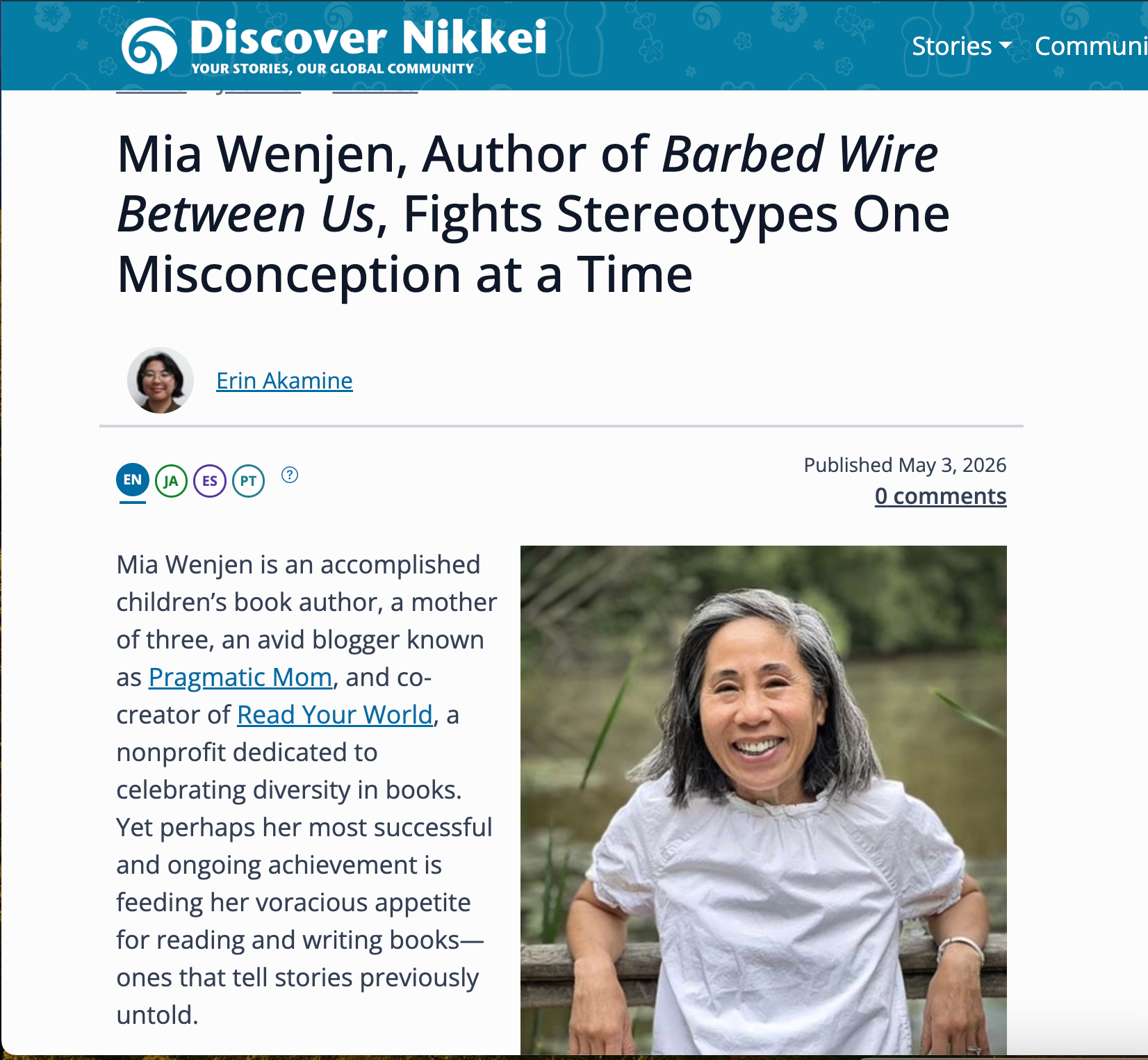
Mia Wenjen is an accomplished children’s book author, a mother of three, an avid blogger known as Pragmatic Mom, and co-creator of Read Your World, a nonprofit dedicated to celebrating diversity in books. Yet perhaps her most successful and ongoing achievement is feeding her voracious appetite for reading and writing books—ones that tell stories previously untold.
Her latest book, Barbed Wire Between Us, aims to shine a light on the cyclical nature of history—telling the parallel narratives of the Japanese American concentration camps from 80 years ago and the current issue of immigrant children forced into detention centers. Using a reverso poem, a poetic form in which the second half reverses the first, Wenjen’s book makes a powerful statement about the injustice of detaining communities and the solidarity that rises up in response.
This book is Wenjen’s latest addition to her catalogue of books written to fill gaps in the children’s literature world. Her determination to see more stories representing people of color and lesser-known history began in elementary school after reading every book in her gym-sized library.
“It took me two and a half years,” Wenjen recalled. “I read every middle grade [book], every chapter book, every biography. I never saw anyone who looked like me. So I grew up thinking, ‘I’m a side character, I’m not the main character.’”
This became an especially concerning issue when she had kids of her own. In 2006, when her six-year-old daughter had a series of substitute teachers in first grade, Wenjen turned to picture books to help her daughter keep up. Reading ten picture books a night and visiting the library three times a week, Wenjen became an expert at finding and browsing through book lists for her children.
In 2009, she started Pragmatic Mom, a blog focused on parenting, education, and books. Alarmed by a study by Lee & Low Publishers stating that diversity in children’s books hadn’t increased in 14 years, Wenjen decided to focus on highlighting diverse children’s books on her blog.
As the daughter of a Nisei mother and Chinese immigrant father, Wenjen received a unique mixture of both cultures. She remembers the ways that her exposure to her Japanese and Chinese heritage influenced her childhood and identity.
“I grew up taking Chinese lessons for a year or two until we rebelled. But then, we’d go to a Buddhist temple when there’s funerals or weddings,” Wenjen recalls. “You don’t necessarily identify in one [culture] or the other. You’re sort of in the middle.”
Her marriage to a Korean American pushed Wenjen to seek out stories about Japanese, Chinese, and Korean people and culture. The combination of collecting and creating book lists for her blog and actively searching for perspectives that reflected her and her children’s experiences gave Wenjen the perfect position to understand where the holes in the genre are.

Fortune Cookies for Everyone!, a book examining the origin of fortune cookies, was an opportunity for Wenjen to discover more about the ways in which Japanese American and Chinese American cuisine shaped the dessert most associated with Chinese American food.
“I was in San Francisco and I saw that [the fortune cookie] was an invention in San Francisco. As I researched it, I [found that] no, it’s actually not clear who invented it,” Wenjen told Discover Nikkei. “It’s a Chinese and Japanese story. I was like, ‘Well, then obviously, I should tell it.’”
The only other book about fortune cookies at the time was Grace Lin’s Fortune Cookie Fortunes, a book that acknowledges the possibility of these sweet treats originating from Japanese American culture but leans toward Chinese mooncakes as the precursor to the Asian American dessert.
Wenjen, unsure about this interpretation, decided to write her own story investigating the ambiguous history of fortune cookies.

When one particular trend saw the release of multiple books about ninjas written by non-Japanese authors, Wenjen responded with Sumo Joe, a story that centers around a boy who likes sumo wrestling and his sister that wants to join his boys-only sumo wrestling fun. Wenjen made sure to research and include many details about the rituals of sumo wrestling to fight misconceptions about the traditional practice.
“I’m just trying to put some people into the spotlight, maybe like what I did as a blogger,” Wenjen reflected. “It’s to correct some erasure, or misrepresentation, or to put things actually how they deserve to be.”
Stories about Asian American history have been particularly susceptible to exclusion from American history textbooks and classrooms, according to Education Week, including the incarceration of Japanese Americans during World War II. The erasure of history is detrimental to recognizing the repeating patterns of injustices.
During Trump’s first term, the administration enacted the “zero-tolerance” policy on immigration in 2018—a policy stating that any migrant attempting to cross the U.S. border through unofficial means would be detained and criminally prosecuted. With adults sent to criminal detention, their children were classified as “unaccompanied,” resulting in the separation of more than 2,000 children from their parents at the southern border.
The ensuing protests and activism, especially from survivors of the Japanese American concentration camps and the Nikkei community, left a lasting impression on Wenjen. Although her mother managed to avoid being sent to the incarceration camps, she instead lived for four years in a tent in a remote part of Utah. Wenjen could imagine her late mother standing alongside the protesters and calling for justice.
The parallels between the unconstitutional imprisonment of the Japanese American community and the inhumane separation of immigrant families prompted Wenjen to write a book highlighting this. Yet finding the correct tone when writing a story centered around the heavy topics of prejudice and harsh living conditions in a children’s book proved to be difficult.

“I took [the manuscript] to a critique group and they’re like, ‘This is not a children’s book. You should write an op-ed for the New York Times.’” Wenjen said. “But I was like, ‘No, there’s a story here somewhere, I just have to find it and be less angry.’”
Even after working on it for years and changing her approach to free verse, Wenjen still struggled to finish the story. Inspiration struck during the pandemic when a picture book event hosted by a public library in Long Beach introduced a new concept to Wenjen.
“She [the librarian] was talking about Amah Faraway by Margaret Chiu Greanias. It was a reverso poem, and the librarian was like, ‘This is a reverso poem, and this is how it works.’” Wenjen remembers. “I was like, ‘Ding, ding, ding!’ I just did some minor tweaks and all of a sudden it was different. I was like, ‘Oh my god, it’s done.’”

The finished product, under 300 words, is striking—a simple narrative accompanied by beautiful illustrations reveals the hardships of a little Japanese American girl thrown behind barbed wire. Despite these unjust circumstances, Wenjen infuses little sparks of hope through the resilience and sense of community within the incarceration camps. At the midpoint, however, the story flips on its head and we find a new protagonist in a little South American girl, one Wenjen imagines to be from Honduras. The same words grace the pages, except this time we see the little South American girl thrown into similarly unjust circumstances.
The illustrations by Violeta Encarnación, a Cuban American illustrator, depict both girls navigating through harsh environments and making the best of their situation. Seen throughout the picture book are origami cranes, first appearing with the little Japanese girl as she folds origami cranes out of newspapers and later with the little South American girl seeing an elderly Japanese lady lacing paper cranes through the barbed wire separating them.
These origami cranes, according to Wenjen, contain a remarkable detail:
“She [Encarnación] found newspapers from 1942,” Wenjen explained. “She has a digital tool that folds them into origami, and she used that for the illustrations.”

While initially symbols of longevity and health in Japanese mythology, cranes took on a new meaning in light of Sadako Sasaki’s efforts to fold 1,000 cranes to grant her wish for recovery from the radiation of the atom bomb—turning cranes into symbols of peace. As the Nikkei community called for justice and nonviolence from the Trump administration, thousands of folded paper cranes were hung on fences surrounding detention centers in solidarity.
“In the midst of [the concentration camps], there was some compassion and kindness,” Wenjen said. “We were that for each other, and we can be that in the future too.”

* * * * *
On May 9, 2026, Mia Wenjen, along with other notable children’s book authors, will read their stories at the Democracy Center of the Japanese American National Museum. To learn more about this event and buy tickets, click this link.
To learn more about Mia Wenjen, visit her website.
© 2026 Erin Akamine
I’ll be at the 2nd Nikkei Children’s Book Festival at the Japanese American National Museum (May 9)
UNBREAKABLE and BARBED WIRE BETWEEN US interview in Publishers Weekly
Barbed Wire Between Us ORIGINAL Song by Daria Music
158 Japanese American Books for Kids & Teens
5 Japanese American Picture Books Celebrating Joy Through Creativity
Celebrating Girls’ Day: A Japanese Holiday called Hinamatsuri
To examine any book more closely at Amazon, please click on image of book.
As an Amazon Associate, I earn from qualifying purchases.
Follow PragmaticMom’s board Multicultural Books for Kids on Pinterest.
Follow PragmaticMom’s board Children’s Book Activities on Pinterest.
My books:

 Amazon / Signed or Inscribed by Me
Barbed Wire Between Us by Mia Wenjen, illustrated by Violeta Encarnación
- ⭐ Starred review from Kirkus
- ⭐ Starred review from Publishers Weekly
- ⭐ Starred review from School Library Journal
- Kirkus: The Most Anticipated Children’s Books of Spring 2026

Amazon / Signed or Inscribed by Me
- California Eureka Non-Fiction Gold Award
- Junior Library Guild Gold Selection
- Notable Social Studies Trade Books for Young People Winner (from National Council for the Social Studies and Children’s Book Council)
The Traveling Taco:
- California Eureka Non-Fiction Silver Award
- Notable Social Studies Trade Books for Young People Winner (from National Council for the Social Studies and Children’s Book Council)
- Reading Rockets’ Summer Reading Guide 2025
 Amazon / Signed or Inscribed by Me
Amazon / Signed or Inscribed by Me
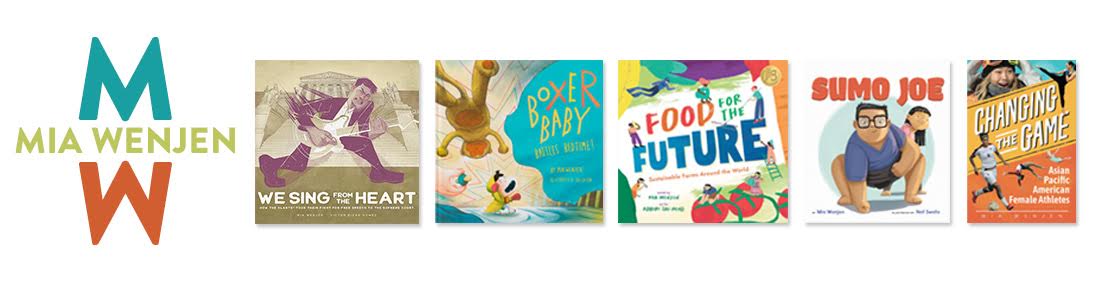
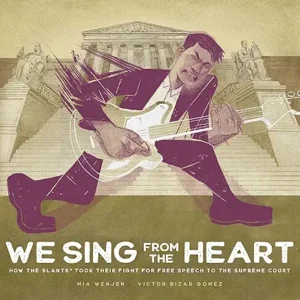
We Sing from the Heart: How the Slants® Took Their Fight for Free Speech to the Supreme Court
- ALSC Notable Children’s Book
- 2025 Carter G. Woodson Book Award Middle Level Honoree
- Orbis Pictus Recommended Book for Outstanding Nonfiction for Children
- 2024 Julia Ward Howe Prize for Children’s Literature Winner
- California Eureka Non-Fiction Award Honor Book
- Notable Social Studies Trade Books for Young People Winner (from National Council for the Social Studies and Children’s Book Council)
- Bank Street Best Children’s Books of the Year 2025
- Recommended Reading for the Social Justice Literature Award 2025 (International Literacy Association)
- Pennsylvania Mountain Laurel Book Award Nominee 2026-27
- Junior Library Guild Gold Selection
 Amazon / Signed or Inscribed by Me
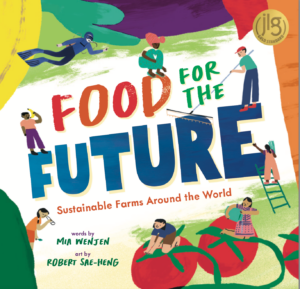 Amazon / Barefoot Books / Signed or Inscribed by Me
Food for the Future: Sustainable Farms Around the World
- ⭐ Starred review from School Library Journal!
- Junior Library Guild Gold selection
- Massachusetts Book Award Long List
- dPICTUS 100 Outstanding Picture Books of 2023
- Chicago Library’s Best of the Best
- 2023 INDIES Book of the Year Awards Finalist
- Green Earth Book Award Long List
- Nautilus Silver Winner, Nonfiction Children’s Picture Book
- Sunshine State Young Readers Award Orange Blossom List for Nonfiction
- Imagination Soup’s 35 Best Nonfiction Books of 2023 for Kids
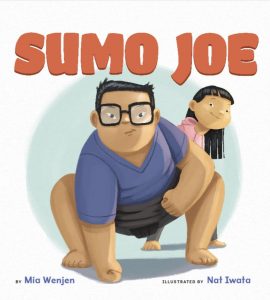
Amazon / Signed or Inscribed by Me
Bank Street College’s The Best Children’s Books of the Year
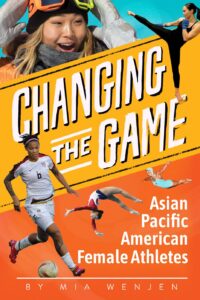 Amazon / Signed or Inscribed by Me
Amazon / Signed or Inscribed by Me