

In Japan, the crane (tsuru) is a symbol of peace, good fortune, and longevity. It is a bird of happiness and spreads good luck. It is believed that folding 1,000 paper cranes (senbazuru) will help to bring about hope, healing, and peace.
These children’s books featuring origami cranes also send a message of hope and peace. In my picture book, Barbed Wire Between Us, origami cranes serve a symbolic purpose both in real life and as a metaphor in the story.

The actual origami cranes in the illustrations by Violeta Encarnacion were made from U.S. newspapers from 1942, the year that people of Japanese ancestry were unfairly sent to concentration camps. Violeta folded these newspapers digitally into origami cranes, a detail that I think is emblematic of the deep connection she had to the story and her creative genius in bringing this reverso poem to life.

Free downloadable Teacher’s Guide:
Barbed Wire Between Us Teacher’s Guide
We are giving away 5 signed copies of Barbed Wire Between Us. To enter, please leave a comment.
11 Children’s Books Featuring Origami Cranes
Yoko’s Paper Cranes by Rosemary Wells
Yoko fed the cranes at her Obaasan’s garden. Ojiisan taught her how to fold origami cranes. When Yoko left Japan, she never forgot her grandparents. Letters went back and forth every week. For her grandmother’s birthday, Yoko sent origami cranes, promising to return one day just like the cranes. This lovely picture book includes instructions on how to fold a paper crane. [picture book, ages 3 and up]

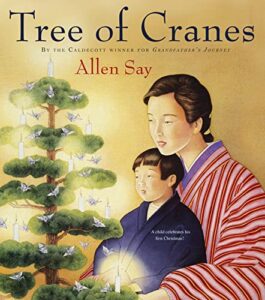
Tree of Cranes by Allen Say
A Japanese boy learns about Christmas from his mother, who was born in California. She decorates the bonsai tree with paper cranes and candles in a merging of two cultures to celebrate peace and love. [picture book, ages 4 and up]
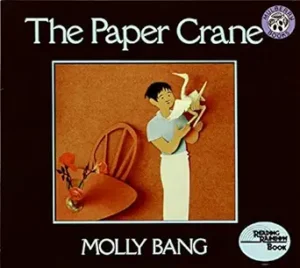
by Molly Bang
This Japanese folk tale is about a restaurant owner whose business was failing. Nevertheless, he gave a fine meal to a poor stranger. The stranger folded a paper napkin into a crane that could come to life and dance. The dancing crane drew people to the restaurant, and it prospered. One day, the stranger came back with a flute that made the crane dance like it never did before. When he was done, he climbed on the crane’s back and disappeared forever. Learn more about the Crane’s Return of a Favor folk tale. [picture book, ages 4 and up]
Here’s another version of that Japanese folktale:
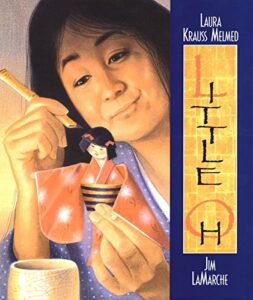
Little Oh by Laura Krauss Melmed and Jim LaMarche
This is a Japanese “Pinocchio” story. A woman folded an origami doll that came to life. She begged her mother to take her to the market, where she ended up separated and far from home. The doll found herself on a sandy beach near a lonely white crane. The crane helped her find her way home, where a miracle happened. Origami cranes are featured in the illustrations. [picture book, ages 5 and up]
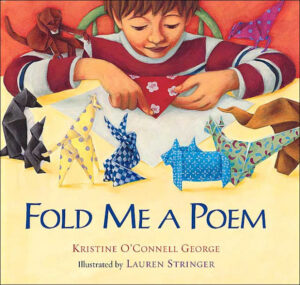
This is a story, told through poetry, of a boy playing with origami animals that he folded. Some of the origami animals are quite complicated to fold. It’s a celebration of imagination, alone time, and an origami genius. The boy never actually folds a crane — it’s probably too simple for him! [picture book, ages 6 and up]
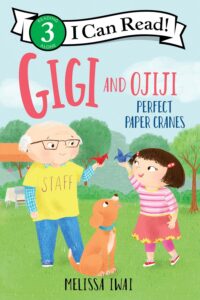
Gigi and Ojiji: Perfect Paper Cranes by Melissa Iwai
Gigi wants to learn how to fold a crane at the Japan Day Festival. Her Ojiji is teaching origami, but his booth has a long line. She learns how to fold a puppy while she waits. When it’s her turn to learn, she struggles. Folding a crane is hard! Finally, she finishes her crane but is dismayed at how it looks compared to Ojiji’s. Her parents and Ojiji praise her for her first origami crane! She stuck with it! Folding an origami crane is complicated![early reader, ages 4 and up]
Barbed Wire Between Us by Mia Wenjen, illustrated by Violeta Encarnación
Japanese-American activists, particularly through the group Tsuru for Solidarity, have used origami cranes as a protest symbol against Trump administration immigrant detention centers.
The cranes, or tsuru, represent a call for freedom and concern for migrant children, specifically targeting the detention of families and asylum seekers.
I was inspired to write this story during Trump’s first administration, where I saw Japanese Americans, many of whom were grandmothers, standing outside of Immigrant Detention Centers, weaving origami crane wreaths into the barbed wire. They were there to stand witness to the atrocities because no one stood up for them when they were forced into concentration camps during WWII. Illustrator Violeta Encarnacion has used newspapers from 1942, the year that people of Japanese descent were incarcerated, for the origami cranes in her illustrations. She weaves this image representing hope, peace, and healing throughout the book. [reverso poem picture book, ages 7 and up]

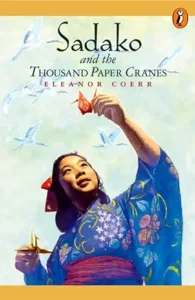
Sadako and the Thousand Paper Cranes by Eleanor Coerr
A story about post-bombing Hiroshima, where Sadako, who loves to run, becomes ill due to the radiation from the bomb. It is believed in Japan that folding a thousand paper cranes brings girls good luck and good health. [middle grade, ages 8 and up]
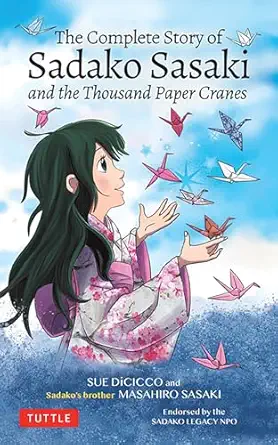
The Complete Story of Sadako Sasaki and the Thousand Cranes by
Sadako Sasaki was two years old when the atomic bomb was dropped on her city of Hiroshima at the end of World War II. Ten years later, just as life was starting to feel almost normal again, this athletic and enthusiastic girl was fighting a war of a different kind. One of many children affected by the bomb, she had contracted leukemia. Patient and determined, Sadako set herself the task of folding 1000 paper cranes in the hope that her wish to be made well again would be granted.
In this nonfiction story, Sadako’s older brother tells the story of his sister with help from Masahiro Sasaki. Tragically, Sadako died at twelve years old. She folded more than 1,300 origami cranes. Her story inspired the Children’s Peace Monument in Hiroshima. [middle grade, ages 8 and up]
More than 38,000 children were killed in the US nuclear bombings of Hiroshima and Nagasaki
in August 1945.
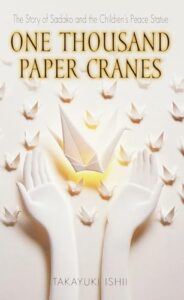
One Thousand Paper Cranes: The Story of Sadako and the Children’s Peace Statue by Ishii Takayuki
A nonfiction companion book to Sadako and the Thousand Paper Cranes, this tells the story of how Sadako’s peace statue came to be. Sadako had actually folded more than 1,500 paper cranes before dying at age 12. She was in 7th grade. Her classmates rallied and created a movement to raise money for a gravestone marker for Sakado. In the end, they raised an astounding $450,000. Her memorial statue stands today in Hiroshima at the Peace Memorial Park. [nonfiction young adult, ages 12 and up]
A Thousand Cranes: Origami Projects for Peace and Happiness by
Now that you can fold origami cranes (I have a video below), here are some ideas for what to do with them. This book includes forty-eight tear-out sheets of colorful chiyogami to get you started. [nonfiction craft book, ages 10 and up]


5 Signed Copies of Barbed Wire Between Us GIVEAWAY!
I am giving away 5 signed copies of Barbed Wire Between Us to 5 winners. To enter, please leave a comment. I can only ship to U.S and A.F.O. addresses.
Congrats to Julie, Destiny, Melanie, Vincent, and Jen! You each won a signed copy of my newest picture book!
p.s. Related posts:
15 Children’s Books on the Hiroshima and Nagasaki Bombings
158 Japanese American Books for Kids & Teens
Resources for Asian Pacific American Heritage Month
How to make an Origami Fortune Cookie!
Origami French Fries: Activity for THE TRAVELING TACO
Fold an Easy Origami Sumo and the Tokyo Olympics
How to Make Origami Shirukan Throwing Star
To examine any book more closely at Amazon, please click on image of book.
As an Amazon Associate, I earn from qualifying purchases.
Follow PragmaticMom’s board Multicultural Books for Kids on Pinterest.
Follow PragmaticMom’s board Children’s Book Activities on Pinterest.
My books:

Bookshop.org / Amazon / Signed or Inscribed by Me
Barbed Wire Between Us by Mia Wenjen, illustrated by Violeta Encarnación
- ⭐ Starred review from Kirkus
- ⭐ Starred review from Publishers Weekly
- ⭐ Starred review from School Library Journal
- Kirkus: The Most Anticipated Children’s Books of Spring 2026
Free and downloadable guide:
Barbed Wire Between Us Teacher’s Guide

Bookshop.org / Amazon / Signed or Inscribed by Me

Bookshop.org / Amazon / Signed or Inscribed by Me
- California Eureka Non-Fiction Gold Award
- Junior Library Guild Gold Selection
- Notable Social Studies Trade Books for Young People Winner (from National Council for the Social Studies and Children’s Book Council)
The Traveling Taco:
- California Eureka Non-Fiction Silver Award
- Notable Social Studies Trade Books for Young People Winner (from National Council for the Social Studies and Children’s Book Council)
- Reading Rockets’ Summer Reading Guide 2025
 Bookshop.org / Amazon / Signed or Inscribed by Me
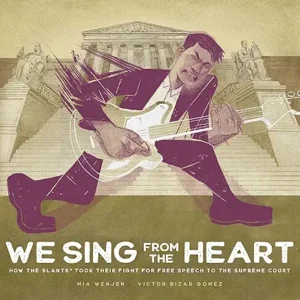
Bookshop.org / Amazon / Signed or Inscribed by Me
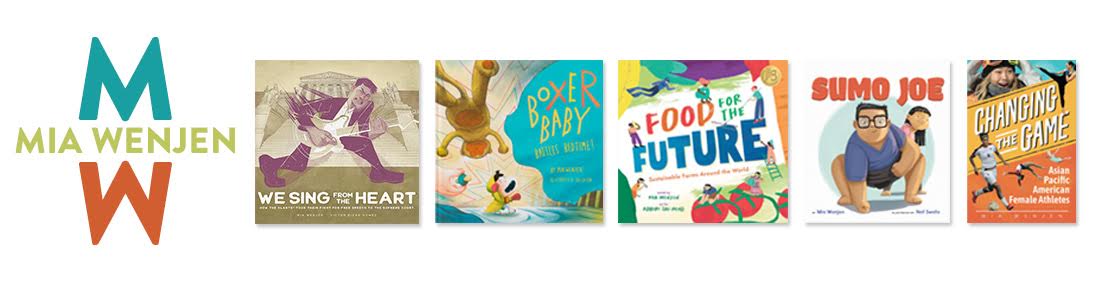
We Sing from the Heart: How the Slants® Took Their Fight for Free Speech to the Supreme Court
- ALSC Notable Children’s Book
- 2025 Carter G. Woodson Book Award Middle Level Honoree
- Orbis Pictus Recommended Book for Outstanding Nonfiction for Children
- 2024 Julia Ward Howe Prize for Children’s Literature Winner
- California Eureka Non-Fiction Award Honor Book
- Notable Social Studies Trade Books for Young People Winner (from National Council for the Social Studies and Children’s Book Council)
- Bank Street Best Children’s Books of the Year 2025
- Recommended Reading for the Social Justice Literature Award 2025 (International Literacy Association)
- Pennsylvania Mountain Laurel Book Award Nominee 2026-27
- Junior Library Guild Gold Selection
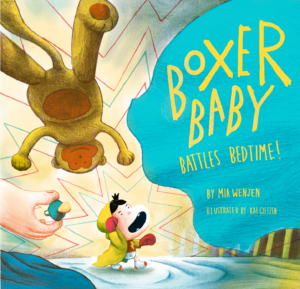 Amazon / Signed or Inscribed by Me
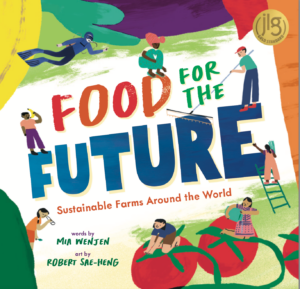 Bookshop.org / Amazon / Barefoot Books / Signed or Inscribed by Me
Food for the Future: Sustainable Farms Around the World
- ⭐ Starred review from School Library Journal!
- Junior Library Guild Gold selection
- Massachusetts Book Award Long List
- dPICTUS 100 Outstanding Picture Books of 2023
- Chicago Library’s Best of the Best
- 2023 INDIES Book of the Year Awards Finalist
- Green Earth Book Award Long List
- Nautilus Silver Winner, Nonfiction Children’s Picture Book
- Sunshine State Young Readers Award Orange Blossom List for Nonfiction
- Imagination Soup’s 35 Best Nonfiction Books of 2023 for Kids
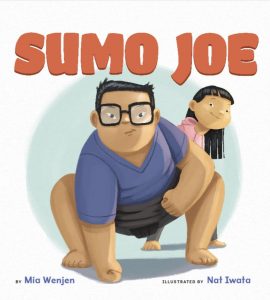
Bookshop.org / Amazon / Signed or Inscribed by Me
Bank Street College’s The Best Children’s Books of the Year
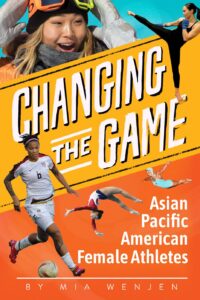 Amazon / Signed or Inscribed by Me
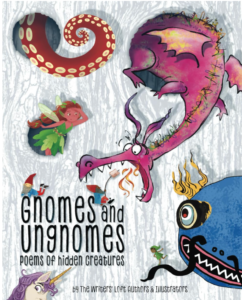
Amazon / Signed or Inscribed by Me
Looking forward to getting these books for my niece and nephew!
Thanks for the book list and video links! I’d love a copy of “Barbed Wire Between Us” for my local laundromat library! It is a fantastic book!
What a collection! Thank you for the links to videos as well. I’d love to win Barnes Wire Between Us for my classroom.
I would love to read Barbed Wire Between Us. This post is very informative and gave me much to think about.
Incredible how nearly all these books are linked by origami and racial discrimination. Great videos for use when promoting these book titles or beginning a read aloud. Thanks, Mia!
When I FINALLY got to read BARBED WITE BETWEEN US, I was totally captivated by the poetic form and the facts behind the text and illustrations. First of all, it seems “we” have learned nothing from the past, as more and more innocent people are held against their will. Using the reverse poetic form was not only new to me, but it serves as a strong carrier for the message. I would love to add this book to my school library.
These books look like they would be fun to read, Mia!