“Teens struggle to distinguish news from opinion and advertising, making intentional news and media literacy instruction a key part of preparing students for civic engagement.” School Library Journal
What is critical thinking?
It means being skeptical. It means wondering about things. It means questioning what you are reading instead of automatically assuming that it’s true.
With the onslaught of online information and our youth spending 4 to 6 hours a day online, teaching critical thinking skills is more important than ever. But how do we do that?
The first step is to evaluate the information presented and identify fact from fiction. What are the different types of fiction?
Misinformation: false or inaccurate information that is spread even though the intent was not to deceive.
Disinformation: false or inaccurate information that is spread with the intent to deceive. See propaganda.
Mal-information: information that is based on truth but exaggerated or shown out of context to attack an idea, individual, organization, country, or other entity.
Fake News: information meant to mislead, manipulate, or create doubt. See misinformation, clickbait, mal-information, and propaganda.
Clickbait: misleading headlines meant to drive traffic.
Propaganda: information designed to manipulate public opinion. See disinformation and fake news.
Take action by fact-checking with these free Fact-Checking Tools:
Common Sense Media suggests digging in to ask:
- Who made this content? What’s their possible motivation for creating it?
- Does the news outlet or content creator seem trustworthy? Why, or why not?
- Who is the audience for this message?
- Is this actual news or an ad? How can you tell?
- Who might benefit or be harmed by this message?
Then, help your kid identify misinformation and disinformation using these tips:
- Be wary of accounts that don’t have a lot of followers or aren’t verified on social media platforms like TikTok and Instagram. This is a good indication to do more research on them before trusting what they say.
- Even when a channel or an account appears to be verified, they could still post clickbait. That’s content designed to influence you to visit a page, video, or image online. Use these tips to identify clickbait.
- Make sure headlines and captions match the content, and always read or view the full post before sharing. It’s not a good idea to believe or spread information based on just the headline.
- Look for signs of low-quality content. Examples include headlines and captions with grammatical errors, bold claims that aren’t backed up by solid sources, overly edited videos, and sensationalist images.
- Check whether other credible outlets are reporting the same news. If not, that doesn’t necessarily mean the news is untrue, but it does mean you should dig deeper. Also, check the date a story or video was posted to make sure you’re getting the most recent information.
- Use Snopes or FactCheck.org to verify news that seems highly unlikely before trusting or sharing it. This can also help you separate fact from opinion.
- Trust your gut. Misinformation and disinformation are created to get extreme reactions out of people. If what you’re seeing or reading makes you feel strong emotions, it could be a sign that something isn’t right.
- Brush up on your media literacy skills and learn how to better spot misinformation and disinformation with games like Get Bad News and Spot the Troll.
Games to Identify Misinformation
iCivics Education: NewsFeed Defenders
Rand.org: Factitious
MediaSmarts: Reality Check
18 Children’s Books on Media Literacy and Fake News
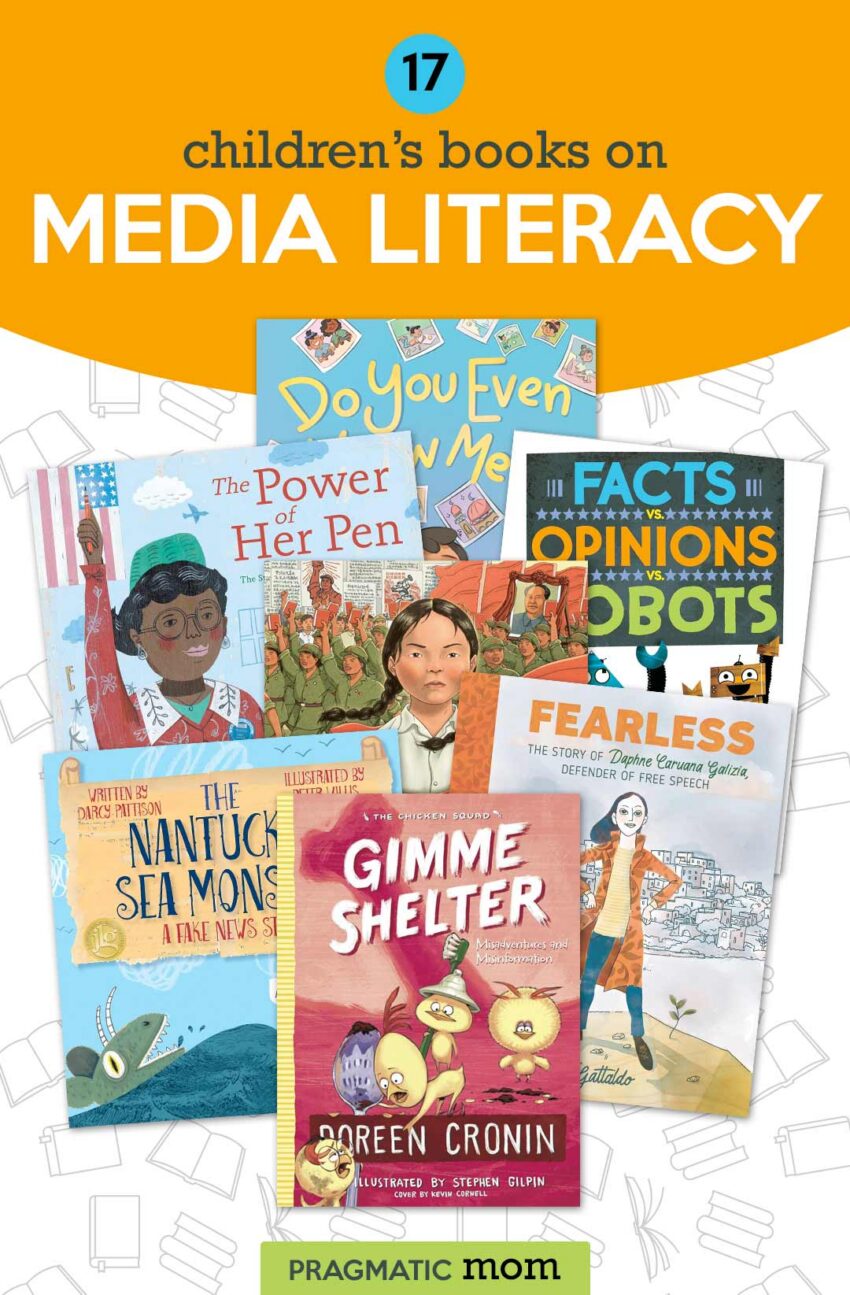
Do You Even Know Me? by Reem Faruqi, illustrated by Ani Bushry
Salma, who is Muslim, overhears the news where a reporter with an angry face uses the word Muslim over and over again. It makes her feel uncomfortable. When she goes to school, a boy bullies her for being Muslim. His news source was the TV. She decides to confront her bully by telling him about what it actually means to be Muslim. He is ashamed and eventually apologizes. [picture book, ages 4 and up]
–> How can misinformation and bullying/cyberbullying be intertwined?
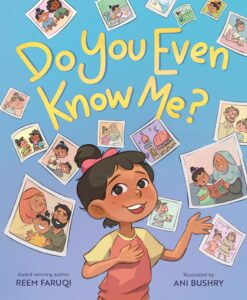
The Power of Her Pen: The Story of Groundbreaking Journalist Ethel L. Payne by Lesa Cline-Ransome, illustrated by John Parra
Ethel L. Payne was one of the first African American White House press correspondents. She asked questions and covered stories that the white mainstream newspapers ignored, such as civil rights issues regarding desegregation, racism in the military, and Black representation in the white house administration. Known as “The First Lady of the Black Press,” Ethel’s reporting helped to create awareness and urgency for issues affecting the Black community. [picture book biography, ages 4 and up]
–> How can news coverage, or lack of news coverage, affect how laws are made and enacted?
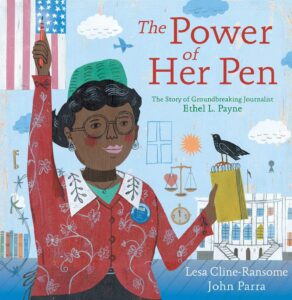
Facts vs. Opinions vs. Robots by Michael Rex
The robots in this picture book help readers distinguish between facts and opinions. [picture book, ages 5 and up]
–> How much information is needed to form an opinion?
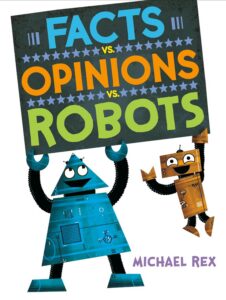
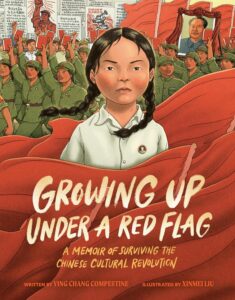
Growing Up Under a Red Flag: A Memoir of Surviving the Cultural Revolution by Ying Chang Compestine, illustrated by Xinmei Liu
Author Ying Chang Compestine describes her life in China as a young girl growing up during the Cultural Revolution. Her father, a surgeon trained by American missionaries, was targeted and imprisoned. For a decade, she and her mother survived during harrowing times. The Cultural Revolution ended with Mao Zedong’s death in 1976. [picture book memoir, ages 6 and up]
–> How was information restricted during the Cultural Revolution?
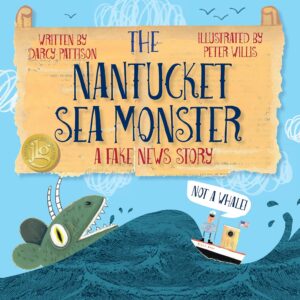
The Nantucket Sea Monster: A Fake News Story by Darcy Pattison, illustrated by Peter Willis
“Hoax: An event planned to fool people.
Publicity: Being mentioned a lot in the news media. The media could be newspaper, radio, television, or online.
Publicity stunt: An event planned to get public attention for marketing purposes.
Credibility: A story or statement that is believable or trustworthy.
Slander: Writing a lie about a person.”
On August 7, 1937, a headline was published about a sea monster spotted off Nantucket. Over the next two weeks, the sightings grew and were featured in the headlines. On August 21, 1937, it was revealed that this sea monster was a stunt meant to generate free publicity for Macy’s Thanksgiving parade. [picture book, ages 7 and up]
–> Who benefited from the free publicity?
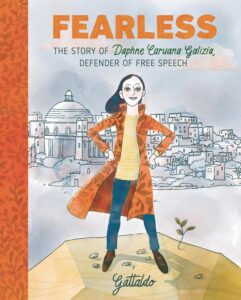
Fearless: The Story of Daphne Caruana Galizia, Defender of Free Speech by Gattaldo
“Books taught Daphne to never let other people think for her. She loved the freedom of asking questions and then making up her own mind.”
Daphne was a human rights journalist in Malta who dared to push back against her government’s fake news. She exposed political corruption involving money laundering and organized crime. When others were afraid to speak out, she created her own blog to publish what her editors were scared to print. She died on October 6, 2017, from a car bomb. Even in death, her voice isn’t silenced, though there is an ongoing disinformation campaign about the cause of her death. [picture book biography, ages 7 and up]
–> How did books help Daphne value truth?
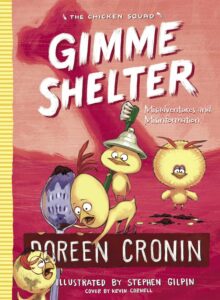
Gimme Shelter by Doreen Cronin, illustrated by Stephen Gilpin
The Chicken Squad digs a storm shelter that morphs into an archaeological dig. Soon, the squirrels and chimps are digging their own holes in the ground for the perceived impending natural disaster. When calamity finally hits, it’s very different from what the animals prepared for. [chapter book, ages 7 and up]
–> How were the chicken’s misadventures caused by misinformation?
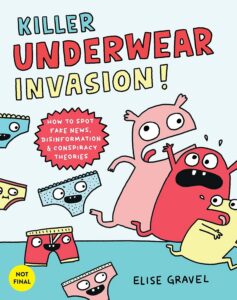
Killer Underwear Invasion!: How To Spot Fake News, Disinformation, & Conspiracy Theories by Elise Gravel
This humorous graphic novel breaks down what false information is and how to spot it. [picture book graphic novel, ages 7 and up]
–> What is confirmation bias?
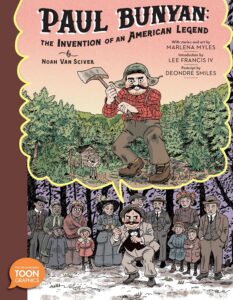
Paul Bunyan: The Invention of the American Legend by Noah Van Sciver, illustrated by Marlena Myles
What is the origin story of the legend of Paul Bunyan? This graphic novel traces it back to an advertising manager for a logging camp back in 1914, where the story mythologized clear-cutting old-growth forests. The tall tale masked the harm done to Indigenous peoples and the land itself. [chapter book graphic novel, ages 7 and up]
–> Who benefited from the legend of Paul Bunyan?
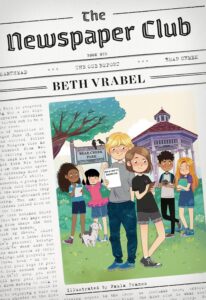
The Newspaper Club by Beth Vrabel
Nellie Murrow and her mother move to Bear Creek, Maine, where the town newspaper has shut down. She decides to create her own newspaper, but she will have to make new friends in order to staff it. There is something suspicious happening in the park. Is it vandalism? She and her new friends are on the case! There is another story to unfold as well regarding Nellie’s father. Is she ready for this reveal? Readers will learn how to start a newspaper, including how to write an article. [chapter grade, ages 7 and up]
–> Why are newspapers important for a town or a school?
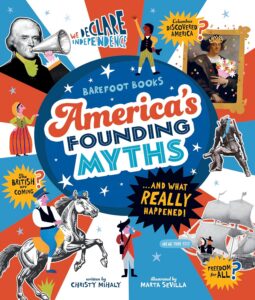
America’s Founding Myths … And What Really Happened by Christy Mihaly, illustrated by Marta Sevilla
Is how a nation presents its history always true, or are there many sides that get swept under the table? In the case of the United States, one founding myth is that Europeans arrived in America, an empty and unpopulated wilderness. The truth is far different. More than 1,000 distinct Native Nations have lived here since time immemorial. This nonfiction book tracks the myths and realities of America’s founding stories and separates the myth from the truth. [nonfiction picture book, ages 8 and up]
–> Why would we cling to history that is untrue? Why is it convenient to portray America’s founding on unoccupied land? What are the ramifications of this myth?
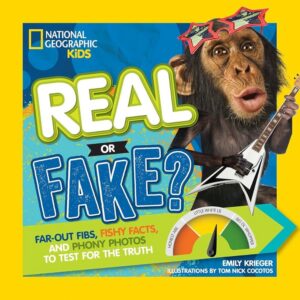
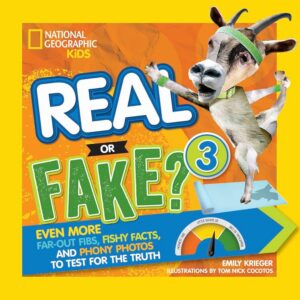
Real or Fake?: Far Out Fibs, Fishy Facts, and Phony Photos to Test for the Truth by Emily Krieger, illustrations by Tom Nick Cocotos
Test your inner lie detector with this series that features stories and scenarios where you decide if they are real or fake. Turn the page to see how you did. Detecting fake photos is especially challenging! Even if readers guess incorrectly, this series offers a wealth of interesting facts on a variety of kid-friendly subjects. [nonfiction picture book series, ages 8 and up]
–> What sets off your inner lie detector when you see stories or photos to decide if they are real or fake?
What Are Conspiracy Theories? by Margaret J. Goldstein
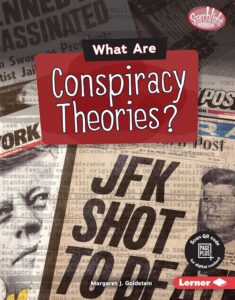
Before the internet, conspiracy theories such as vaccines and fluoride in drinking water are dangerous, and the moon landing was staged, spread more slowly. They have one thing in common: the conspirators are powerful and far-reaching. This book shows readers how to research conspiracy theories to debunk them yourself. [nonfiction picture book, ages 8 and up]
–> How should information be evaluated to determine if it’s true or false?
Can You Believe It?: How to Spot Fake News and Find the Facts by Joyce Grant, illustrated by Kathleen Marcotte
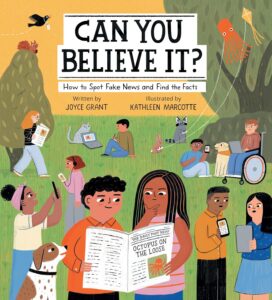
“It’s impossible to include everyone’s point of view in every news article, but there are some points of view that seem to be left out more often. People of color, the LGBTQIA+ community, women and others who aren’t male, people with disabilities, and Indigenous people — their perspectives may be missing from news reports.”
This is a primer on telling the difference between fact and fake news. [nonfiction middle grade picture book, ages 9 and up]
–> Why are some points of view left out?
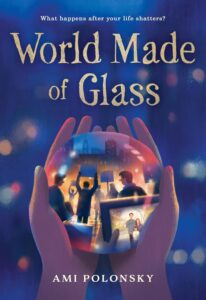
World Made of Glass by Ami Polonsky
“One of the big problems with AIDS is that most people know nothing about it. Lots of people think you can catch it from sharing a bathroom with someone who has it, or drinking from the same water fountain, but neither of them is true.” World Made of Glass is set in 1987.
Iris’ father had AIDS, and after he died, she found comfort in the AIDS activism group her father was a member of. Her friends at school didn’t know about her father’s medical condition. When they come to visit her after his death, their discomfort about potentially catching AIDS infuriates her. But her friends surprised her in their willingness to learn about the AIDS epidemic and have a plan to make a difference. [middle grade, ages 10 and up]
–> What happens when an issue is marginalized, and the media doesn’t cover it? How does that contribute to misinformation?
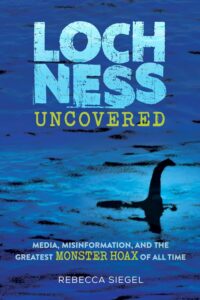
Loch Ness Uncovered: Media, Misinformation, and the Greatest Monster Hoax of All Time by Rebecca Siegel
“Fake news is the name for media stories that are false or deliberately misleading… And although the term fake news gained popularity in the 2016 American presidential election, it is actually a centuries-old issue. It was part of the French Revolution and a part of the American Revolutionary War.”
In 1934, a photo of the Scottish Loch Ness Monster appeared in London’s newspaper, Daily Mail. It became a worldwide sensation that was eventually revealed to be a hoax. And yet today, about one in four Scots believe in the Loch Ness Monster. This is a cautionary tale about the power of Fake News. Chapter 22 offers tips on how to identify Fake News by becoming media literate [nonfiction middle grade, ages 10 and up]
–> Aldie Maclay was the first person to spot the Loch Ness Monster on April 14, 1933. She had a loch side hotel that faced declining tourism. What are the different ways Fake News can generate money?
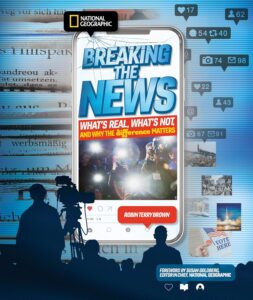
Breaking the News: What’s Real, What’s Not, and Why the Difference Matters by Robin Terry Brown
“False stories travel six times faster on Twitter/X than real stories do.”
This is a comprehensive look at the history of news and media. Chapter 3 covers propaganda, half-truths, and hoaxes, including the power of images. Chapter 6 dives into uncovering the truth, including photos [nonfiction middle grade, ages 10 and up]
–> What are a few things to look for to determine if a photo is fake?
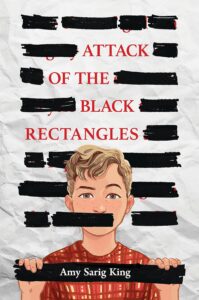
Attack of the Black Triangles by Amy Sarig King
Mac’s teacher passes out copies of Jane Yolen’s The Devil’s Arithmetic to his reading group, but some of the words are blacked out. This teacher is known for her conservative opinions, which she posts in the town newspaper supporting the strict rules of the town, such as outlawing Halloween, the sale of candy, and requiring all the houses to be painted white. When Mac and his friends find out what the blacked-out words are, they are outraged and decide to fight back. Their principal isn’t much help, so they escalate their efforts. By rallying against censorship, Mac learns that a single person can make a difference, especially when it comes to fighting for the truth. [middle grade, ages 11 and up]
–> How does their teacher justify censoring their classroom books?
p.s. Related posts:
The Ultimate Guide for Protecting Kids Online
6 Children’s Books Where the Character Takes Over the Story
My Honest Review of TWO TRUTHS AND A LIE
To examine any book more closely at Amazon, please click on image of book.
As an Amazon Associate, I earn from qualifying purchases.
Follow PragmaticMom’s board Multicultural Books for Kids on Pinterest.
Follow PragmaticMom’s board Children’s Book Activities on Pinterest.
My books:

 Amazon / Signed or Inscribed by Me
Barbed Wire Between Us by Mia Wenjen, illustrated by Violeta Encarnación
- ⭐ Starred review from Kirkus
- ⭐ Starred review from Publishers Weekly
- ⭐ Starred review from School Library Journal
- Kirkus: The Most Anticipated Children’s Books of Spring 2026

Amazon / Signed or Inscribed by Me
- California Eureka Non-Fiction Gold Award
- Junior Library Guild Gold Selection
- Notable Social Studies Trade Books for Young People Winner (from National Council for the Social Studies and Children’s Book Council)
The Traveling Taco:
- California Eureka Non-Fiction Silver Award
- Notable Social Studies Trade Books for Young People Winner (from National Council for the Social Studies and Children’s Book Council)
- Reading Rockets’ Summer Reading Guide 2025
 Amazon / Signed or Inscribed by Me
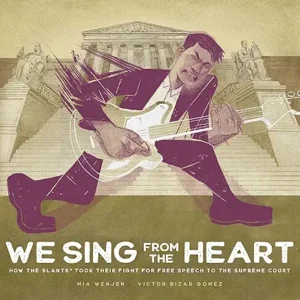
Amazon / Signed or Inscribed by Me
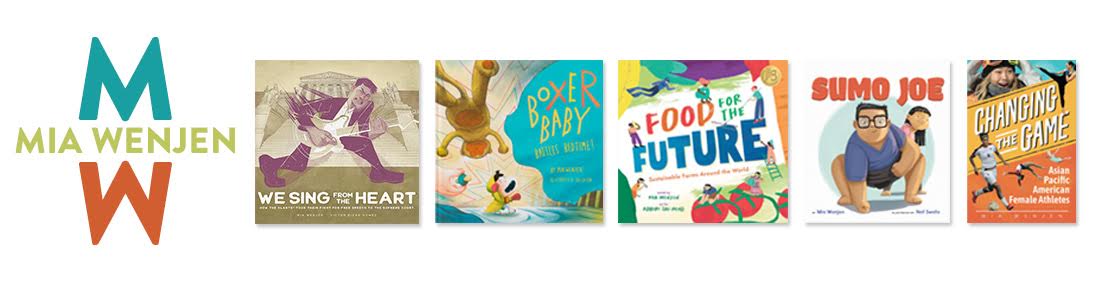
We Sing from the Heart: How the Slants® Took Their Fight for Free Speech to the Supreme Court
- ALSC Notable Children’s Book
- 2025 Carter G. Woodson Book Award Middle Level Honoree
- Orbis Pictus Recommended Book for Outstanding Nonfiction for Children
- 2024 Julia Ward Howe Prize for Children’s Literature Winner
- California Eureka Non-Fiction Award Honor Book
- Notable Social Studies Trade Books for Young People Winner (from National Council for the Social Studies and Children’s Book Council)
- Bank Street Best Children’s Books of the Year 2025
- Recommended Reading for the Social Justice Literature Award 2025 (International Literacy Association)
- Pennsylvania Mountain Laurel Book Award Nominee 2026-27
- Junior Library Guild Gold Selection
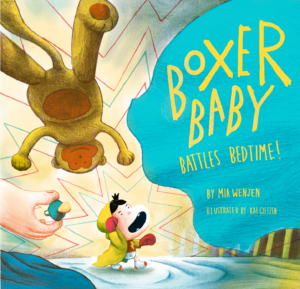 Amazon / Signed or Inscribed by Me
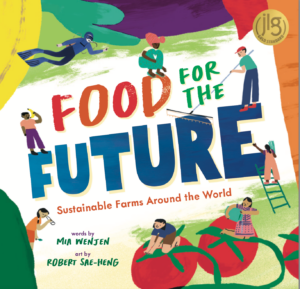 Amazon / Barefoot Books / Signed or Inscribed by Me
Food for the Future: Sustainable Farms Around the World
- ⭐ Starred review from School Library Journal!
- Junior Library Guild Gold selection
- Massachusetts Book Award Long List
- dPICTUS 100 Outstanding Picture Books of 2023
- Chicago Library’s Best of the Best
- 2023 INDIES Book of the Year Awards Finalist
- Green Earth Book Award Long List
- Nautilus Silver Winner, Nonfiction Children’s Picture Book
- Sunshine State Young Readers Award Orange Blossom List for Nonfiction
- Imagination Soup’s 35 Best Nonfiction Books of 2023 for Kids
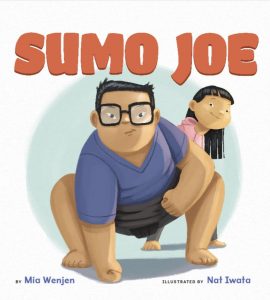
Amazon / Signed or Inscribed by Me
Bank Street College’s The Best Children’s Books of the Year
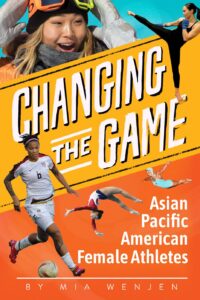 Amazon / Signed or Inscribed by Me
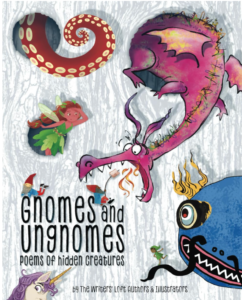
Amazon / Signed or Inscribed by Me