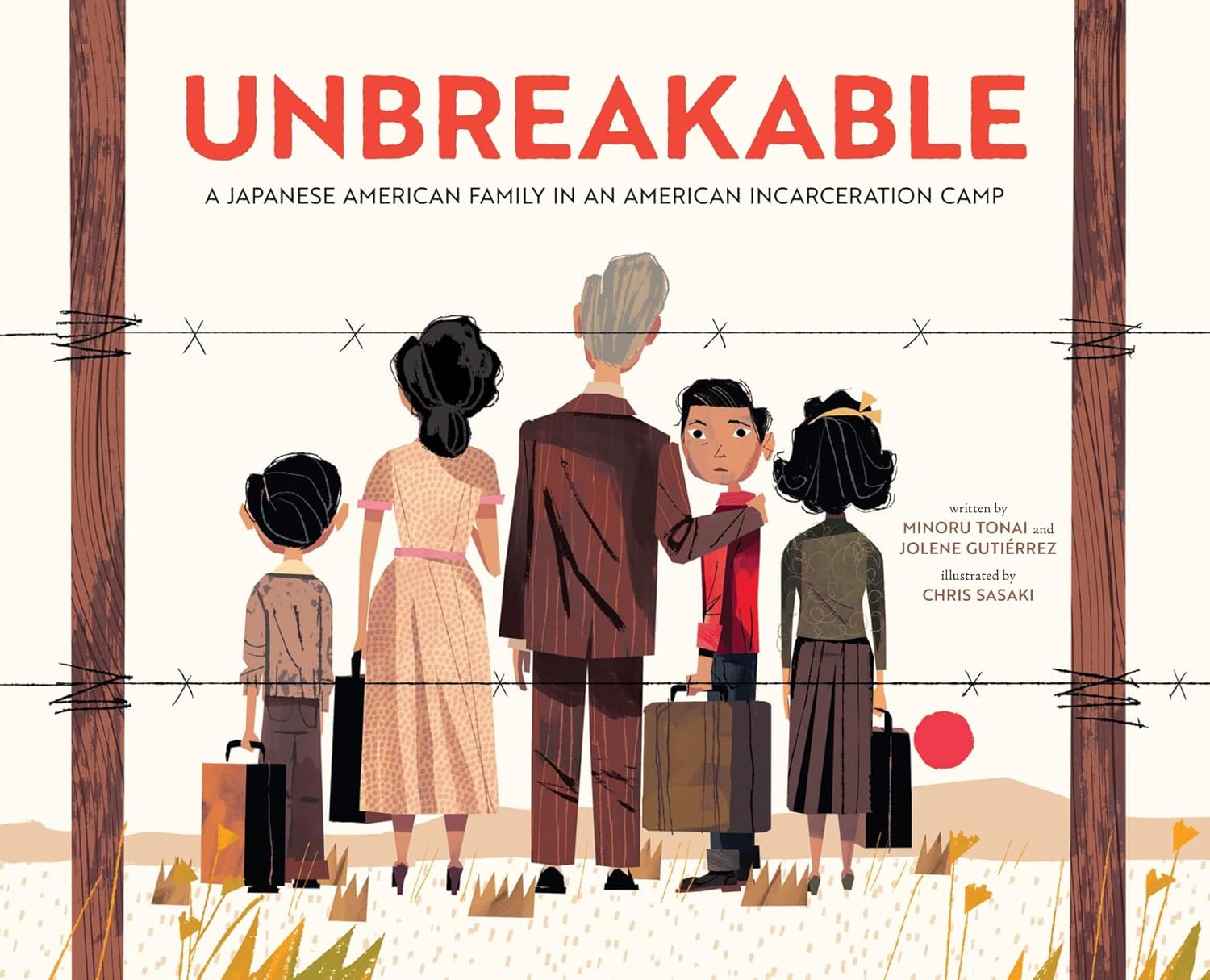
Mia Wenjen and Jolene Gutiérrez both grapple with the cruelty of internment and family separation in their new picture books Barbed Wire Between Us and Unbreakable: A Japanese American Family in an American Incarceration Camp, respectively. The two authors spoke about depicting difficult subject matter for young readers, carrying on the legacy of late author and collaborator Minoru Tonai, and the importance of remembering painful pieces of history.
Jolene Gutiérrez: Mia, your reverso poem in Barbed Wire Between Us was such a powerful way to portray the experiences of imprisoned children when Fort Sill was an internment camp in the 1940s, and then again nearly 80 years later when it served as a detention center. What challenges did you encounter as you tried to structure the poem for both experiences?
Mia Wenjen: It took me a long time to figure out how to make this a children’s book. One of my critique partners read an earlier attempt and told me to write an op-ed instead because my manuscript was too bleak. I rewrote it as a free verse poem, but it still didn’t feel complete. During Covid lockdown, I happened to watch a librarian at a public library in Long Beach, California give a book talk about Amah, Faraway by Margaret Chiu Greanias. She explained that it was a reverso poem. Something clicked, and I immediately ran to my computer to see if I could turn my manuscript into a reverso poem. It only needed a few tweaks—mostly removing a few lines and words to make it work.
And your book is a powerful truth that is often omitted from history books in schools. How did you come into Minoru Tonai’s story? Minoru passed away in 2023. Did you feel like you were racing against a clock to capture the full essence of his story?
Photo of Mia Wenjen by Jerry Russo
Gutiérrez: I came to this story precisely because this truth is omitted from history books! I first learned about the imprisonment of people of Japanese heritage from my grandparents. They lived near the Amache Incarceration Camp and told me the history of the site. I remember being so angry that I hadn’t learned this in any of my history classes, so as a teacher librarian, I started teaching lessons about Amache and other incarceration sites. In 2016, I decided to write a book about Amache. When I interviewed Min, his story was so powerful that I asked if he’d like to work together to tell it. His trust and willingness to work with me was such a gift. We’d signed the contract and he helped choose Chris Sasaki as the illustrator before he passed. I’m so glad he knew his story would be in the world.
When I read your author’s note, I learned that members of the Chiricahua Apache tribe were also held in Fort Sill in the 1880s. Did you ever consider weaving in a third perspective?
Wenjen: The setting in Fort Sill came after I finished the reverso poem. I wondered if there were locations that housed both Japanese American “Internment” Concentration Camps and “Kids in Cages” detention centers. I discovered Fort Sill and its history of imprisoning Native Americans without due process. Each group represented a different century, and that felt like it furthered the metaphor of a reverso poem as history repeating itself. I am glad that I could sneak the third group into the book because I wasn’t able to include it as part of the poem.
You use rocks as a metaphor for strength and beauty in your book, and it’s an anchor for the story. Was this something that you thought of in your first draft, or was it a process for the “rocks as metaphor” to find its way into your story?
Jolene Gutiérrez
Gutiérrez: The rocks are so important! Min and I had spent years working on various iterations of this story. In 2020, I was watching him give a virtual presentation, and he told the story of the FBI finally releasing his father and sending him to Amache to rejoin his family. Min greeted his father and tried to help carry his suitcase. It was so heavy that he asked his father about it, and his father told him he’d collected rocks from every prison the FBI had held him in. Min and his father used those rocks to make a rock garden in front of their barracks at Amache. I knew that Min and his father collected rocks and made rock gardens, both before Min and his family were imprisoned and once they were released and came back home, but this was the first time I’d heard Min share the rocks-in-the-suitcase story. Then, it clicked: we needed that throughline of rocks! The only fictional element of the book is the rock that Papa gives Min before the FBI takes him away. We thought that was an important element to show their connection, even when they were separated.
One of the lines in your book is, “Our family was separated.” During the 1940s, we see the main character and her father being torn apart, and around 2014, we see a father’s hand holding that main character’s hand through a fence. Why do you believe these painful scenes are important to include in this story?
Wenjen: There were many ways that Japanese American families were separated by WWII “Internment” Camps. The young men might have joined the military like illustrator Chris Sasaki’s grandfather. My uncle also joined the 442nd. Japanese American students were sometimes allowed to stay on campus at their college, but not all. USC, for example, refused to let them stay. Family separation occurs both in the past and currently. I am lucky that the illustrator, Violeta Encarnación, depicted these scenes with such an emotional punch.
My mother and her generation didn’t talk about their WWII experiences. What was it like to get Min to talk about his experience of being separated from his father and sent to both the Assembly Center and Amache in Colorado?
Gutiérrez: I’ve learned that many people didn’t want to revisit those horrifying times, and I understand that. Min was 16 when he and his family were released, and for the rest of his life, he spoke out against what had happened. He volunteered to share his story with schools, created networks among survivors, and recorded hours of oral history with Densho. He was always happy to talk to anyone who wanted to learn about this time period. He said, “We were prisoners of our own country, though we were not guilty of any crime, just our ancestry. There was no justice for us. I can’t get over it, because it was wrong, and I have to make sure that it never happens again to anyone else. I’m not afraid to speak up. The experience we had has made me determined that no one else should ever, ever experience that again.”
Barbed Wire Between Us by Mia Wenjen, illus. by Violetta Encarnación. Red Comet, $19.99 Mar. 31; ISBN 978-1-6365-5192-0
Unbreakable: A Japanese American Family in an American Incarceration Camp by Minoru Tonai and Jolene Gutiérrez, illus. by Chris Sasaki. Abrams, $19.99 Apr. 7; ISBN 978-1-4197-7289-4